



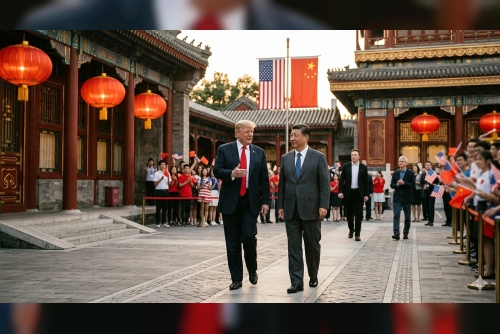
President Donald Trump’s arrival in Beijing this week marks the first U.S. presidential state visit to China in nearly a decade—a high-velocity "reboot" of the world’s most critical bilateral relationship. Greeted by Vice President Han Zheng and enthusiastic crowds at the airport, the summit at the Great Hall of the People has quickly moved from ceremonial pomp to the heavy lifting of global "human architecture."
The Strategic Calculation: Energy and Security
At the heart of the first-day discussions was a "security-first" focus on the escalating conflict in the Middle East. In a rare point of strategic consensus, both leaders agreed that Iran can never possess a nuclear weapon. This alignment is crucial for stabilizing the global supply chain, specifically regarding the Strait of Hormuz. With oil shipments facing systemic risk, Trump and Xi issued a joint commitment to keep this maritime artery open. For the American household, this isn't just diplomacy—it's a necessary "patch" to prevent fuel costs from spiraling and to ensure the free flow of global energy resources.
Tech Diplomacy: The "Version 2.0" Economy
Perhaps the most visually striking element of the summit was the presence of America’s leading tech innovators. In a move that signals a shift toward a more collaborative industrial "code," President Trump introduced a delegation of CEOs to President Xi, including:
Elon Musk (Tesla/SpaceX): Who drew significant digital attention by bringing his son, dressed in traditional Chinese attire, for selfies with local crowds.
Tim Cook (Apple): Discussing the "opening wider" of Chinese markets for American firms.
Jensen Huang (Nvidia): Highlighting the foundational role of AI and high-performance hardware in the modern trade relationship.
Xi’s message to these "brilliant people" was clear: China’s door is not just open, but expanding. This "win-win" framework aims to move past the "bugs" of the 2025 trade frictions and toward a more predictable, managed stability.
The Bottom Line
While tensions remain—highlighted by firm warnings from Xi regarding Taiwan and a brief Secret Service standoff with Chinese security—the tone remains pragmatic. By focusing on qualitative deliverables like Boeing jet deals, soybean exports, and regional stability, both leaders are attempting to stabilize the global "operating system."
As talks continue into Friday and preparations begin for Xi’s reciprocal visit to the White House in September, the goal is clear: double down on the values that make each system work while ensuring the world doesn't crash under the weight of geopolitical instability.