



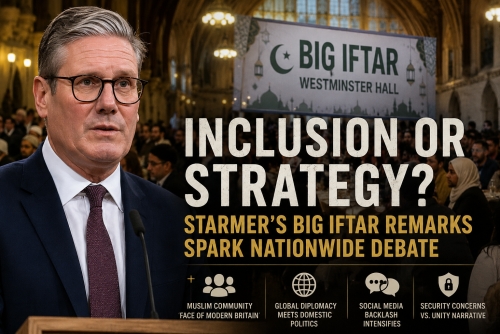
Prime Minister Keir Starmer’s recent address at the "Big Iftar" in Westminster Hall has sparked a high-velocity debate over the "human architecture" of the United Kingdom. By describing the Muslim community as the "face of modern Britain" and "exceptional people" who have shaped the nation’s history through art and education, Starmer attempted to frame the UK as a "community of communities".
However, in the current digital landscape, words of inclusion are rarely isolated from the "bugs" of international diplomacy and domestic political strategy.
The Narrative of Contribution
Starmer’s remarks were a deliberate attempt to highlight the "success story" of British diversity. He focused on qualitative metrics:
Historical Integration: Positioning Muslim contributions as foundational to the British story rather than an external addition.
Creative Excellence: Citing achievements in the arts and education as evidence of a "brilliant and creative" demographic.
Social Cohesion: Using Ramadan as a metaphor for "community and decency" to drown out divisive rhetoric.
The Digital Backlash: A "System Conflict"
The widespread backlash on social media highlights a critical friction point where cultural praise meets geopolitical reality. The timing of these remarks coincided with a "security-first" crisis in the Middle East, leading to several layers of critique:
The "Pandering" Bug: Critics, including voices from the United States and domestic commentators, accused the Prime Minister of "courting the Muslim vote" to recover plummeting support—which polls suggest has dropped significantly due to the government's stance on international conflicts.
Geopolitical Alignment: The rebuke from the White House, suggesting Starmer was prioritizing a specific constituency over a "Churchill-style" alliance with Western partners, created a narrative of "weakness" that resonated across social feeds.
The Oversight Debate: Opponents argued that focusing on "exceptionalism" ignores systemic concerns regarding integration and radicalization, framing Starmer’s inclusive language as a "denial of the security threshold".
The Bottom Line
We are seeing a profound tension between legislative accountability and cultural identity. Starmer is attempting to run a "system update" on the British narrative to foster unity, but the "operating system" of public opinion is currently overwhelmed by the friction of global instability. When a leader defines the "face" of a nation, is it an act of insightful curation or a strategic maneuver to stabilize a fracturing base?