



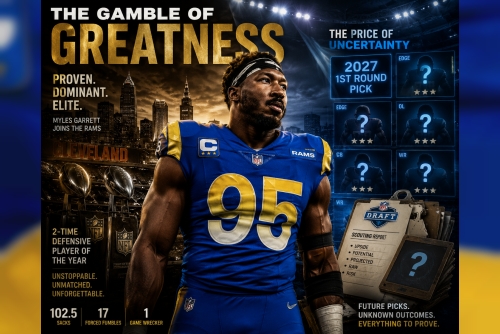
The Cleveland Browns are reportedly finalizing a blockbuster deal that will send two-time Defensive Player of the Year Myles Garrett to the Los Angeles Rams in exchange for Pro Bowl edge rusher Jared Verse, a 2027 first-round pick, and additional draft compensation.
On paper, the trade appears to give both teams something they want. The Browns receive a young talent and future assets, while the Rams land one of the most dominant defensive players of his generation.
But history suggests that when teams trade away elite superstars, the franchise giving up the proven player often takes the biggest risk.
The Value of a Guaranteed Superstar
NFL executives love draft picks because they represent possibility.
Fans dream about finding the next Aaron Donald, Patrick Mahomes, or Micah Parsons. The problem is that most draft picks never become players of that caliber.
Myles Garrett is not a projection.
He is not a prospect.
He is not a gamble.
He is a known commodity who has already proven he can dominate games, change offensive game plans, and elevate an entire defense.
Players capable of consistently generating double teams and disrupting every snap are among the rarest assets in professional sports.
Why the Rams Are Taking a Championship Approach
The Rams have built a reputation for aggressively pursuing elite talent rather than hoarding draft picks.
Their philosophy is simple:
Championship windows are short.
When a proven superstar becomes available, future draft selections become less valuable than immediate impact.
Garrett instantly upgrades the Rams defense and gives opposing quarterbacks another nightmare to worry about every week.
For a team looking to compete now, acquiring an established Hall of Fame-caliber player makes strategic sense.
Why the Browns Are Betting on the Future
From Cleveland's perspective, the trade represents a long-term investment.
Jared Verse is a talented young edge rusher with significant upside.
The first-round pick could become another cornerstone player.
Additional draft compensation provides flexibility for future roster construction.
The challenge is that future assets come with uncertainty.
Even highly rated prospects fail every year.
A first-round pick may eventually become a star—or it may never approach Garrett's level of production.
That uncertainty is what makes blockbuster trades so controversial.
The NFL's Eternal Debate
This trade highlights one of the NFL's oldest questions:
Would you rather have one elite superstar or several chances to find one?
Supporters of the Browns will argue that the team gains youth, flexibility, and multiple opportunities to improve the roster.
Supporters of the Rams will argue that elite players are nearly impossible to replace and should rarely be traded away.
Both arguments have merit.
But history tends to favor teams that acquire proven greatness rather than gamble on potential.
What Happens Next?
The ultimate verdict on this trade will not come for several years.
If Jared Verse develops into a dominant pass rusher and the draft picks become productive starters, Cleveland may emerge as the winner.
If Garrett helps the Rams make deep playoff runs or contend for another Super Bowl, Los Angeles will feel justified in paying a premium.
For now, one thing is certain:
The Rams acquired one of the NFL's most feared defenders, while the Browns placed a massive bet on the future.
And in the NFL, betting against a player of Myles Garrett's caliber has never been a comfortable position.