



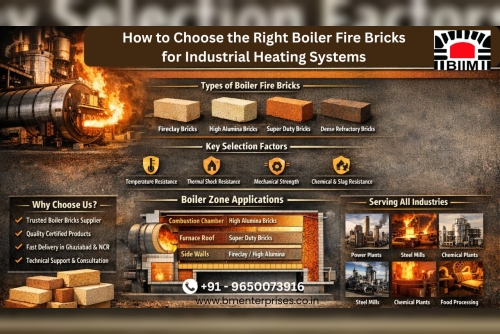
The industrial boiler forms the thermal backbone of manufacturing plants, power generation units, chemical processing facilities, textile mills, food industries, and metal works. These systems operate in continuous leading-edge temperature, pressure loads, and corrosive atmospheres. Boiler fire bricks are critical refractory linings within the heart of their thermal containment structure.
Selection of the right refractory boiler bricks is not just a question of choosing between materials, but rather it's an engineering decision that influences heat economy, fuel economy, equipment life, period between maintenance operations, and plant safety. The present detailed guide will explain every technical and commercial factor you must evaluate before finalising your boiler brick procurement.
What Are Boiler Fire Bricks?Boiler fire bricks are solid refractory blocks made of fireclay, high-alumina, and other ceramic materials. These are specialised blocks made to:
Withstand sustained high temperatures Resist slag and ash corrosion Providing thermal insulation Maintain structural integrity under load Reduce heat loss from the combustion chamberThese bricks are lined on the inside of:
Steam boilers Power plant boilers Fluidised bed boilers Package boilers Waste heat recovery boilersHigh-quality boiler fire bricks ensure that generated heat remains contained within the furnace envelope, improving combustion and energy transfer efficiency.
Temperature Classification of Boiler BricksTemperature rating is the first technical parameter to evaluate. Bricks must exceed the maximum operating temperature of the boiler zone where they will be installed.
Brick GradeTemperature RangeTypical ApplicationLow DutyUp to 1,000°COuter lining, insulation backupMedium Duty1,000–1,250°CSmall industrial boilersHigh Duty1,250–1,400°CCoal & oil-fired boilersSuper Duty1,400°C+Power plants & heavy furnacesUsing under-rated bricks leads to deformation, spalling, and premature lining failure.
Refractory Raw Material CompositionThe mineral composition determines chemical resistance and thermal strength.
1. Fireclay Bricks Alumina content: 25–40% Cost-effective Suitable for moderate heat zones 2. High Alumina Bricks Alumina content: 50–80% Higher refractoriness Better slag resistance Ideal for combustion chambers 3. Super High Alumina / Special Refractories Alumina content: 80%+ Used in ultra-high temperature boilersFor most heavy industrial heating systems, high-alumina refractory boiler bricks deliver the best lifecycle value.
Physical & Mechanical Properties to Evaluate Bulk DensityHigher density bricks provide:
Better load-bearing capacity Higher heat storage Improved erosion resistance Cold Crushing Strength (CCS)Indicates the brick’s ability to withstand compressive loads inside boiler structures.
Typical CCS range:
Fireclay: 150–300 kg/cm² High Alumina: 300–600 kg/cm² PorosityLower porosity ensures:
Reduced slag penetration Better corrosion resistance Longer service life Thermal Performance CharacteristicsThermal Conductivity
Lower conductivity bricks act as better insulators, reducing heat loss and saving fuel.
Specific Heat Capacity
Higher heat storage stabilises furnace temperature during fuel fluctuations.
Thermal Shock Resistance
Critical for boilers undergoing:
Frequent startups & shutdowns Load variations Rapid cooling cyclesPremium boiler fire bricks are manufactured with a controlled grain structure to handle thermal stress without cracking.
Boiler Zone–Wise Brick SelectionIndustrial boilers are not lined with a single brick type. Each zone demands different refractory properties.
Combustion Chamber Requires: High alumina bricks Reason: Direct flame exposure Furnace Roof Requires: Super-duty bricks Reason: High radiant heat + load stress Side Walls Requires: Medium/high-duty bricks Reason: Insulation + abrasion resistance Grate Area / Burner Blocks Requires: Dense, thermal shock-resistant bricks Correct zoning increases the lifespan of the lining by 25–40%. Chemical & Fuel CompatibilityFuel type determines chemical attack risk.
Fuel TypeBrick RequirementCoal FiredSlag-resistant, high-aluminaBiomassAlkali-resistant bricksOil FiredDense low-porosity bricksGas FiredThermal shock-resistant bricksSelecting incompatible refractory boiler bricks results in slag bonding, erosion, and lining collapse.
Dimensional Accuracy & Installation QualityPrecision brick sizing ensures:
Uniform joints Reduced mortar consumption Better thermal sealing Faster installationStandard sizes commonly used:
9” × 4.5” × 3” 9” × 4.5” × 2.5” Custom arch/wedge shapesA professional boiler bricks supplier provides customised shapes for burner throats, arches, and curved linings.
Mortar & Castable CompatibilityBricks alone do not ensure lining durability. Compatible refractory mortar is essential.
Key considerations:
Same alumina grade as bricks Matching thermal expansion rate High bonding strengthIntegrated supply from a single boiler brick manufacturer in India ensures material compatibility.
Lifecycle Cost vs Purchase CostMany buyers make the mistake of choosing the lowest-priced bricks. However, refractory evaluation must consider lifecycle economics:
ParameterLow-Quality BricksPremium BricksInitial CostLowModerateFuel LossHighLowMaintenanceFrequentMinimalLifespan6–12 months2–5 yearsPremium boiler fire bricks reduce total operating expenditure significantly.
Supply Chain & Logistics ConsiderationsTimely refractory availability is crucial during shutdown maintenance.
Sourcing boiler bricks in Ghaziabad or fire bricks in Ghaziabad ensures:
Ready stock availability Faster dispatch Lower freight cost Reduced breakage risk Emergency supply supportLocalised warehousing minimises plant downtime.
Quality Certifications & Testing StandardsAlways verify supplier testing credentials.
Key tests include:
Refractoriness Under Load (RUL) Pyrometric Cone Equivalent (PCE) CCS Testing Bulk Density Testing Permanent Linear Change (PLC)Certified refractory boiler bricks guarantee predictable high-temperature performance.
Packaging & Handling StandardsImproper packaging causes transit damage.
Reliable suppliers provide:
Wooden pallet packing Shrink wrapping Moisture protection Batch labeling Breakage replacement assuranceThis is especially important for bulk industrial orders.
Why Choose BM Enterprises?By providing technically engineered refractory solutions for industrial heating systems, BM Enterprises has made a name for itself as a reliable boiler brick supplier.
Strengths of the Product
Boiler fire bricks with a high density High grades of alumina refractory Bricks resistant to thermal shock Slag and corrosion-resistant materialBenefits of the Service
Industrial supply in bulk In NCR, the ready stock Competitive rates Technical advice Quick logistics for dispatchBM Enterprises provides both product quality and supply assurance for businesses looking for a reputable boiler brick manufacturer in India or quick delivery of boiler bricks and fire bricks in Ghaziabad.
Final Technical Checklist Before PurchaseBefore completing your order, make sure:
Range of operating temperatures Compatibility of fuel types Alumina percentage required Density ratings and CCS Brick dimensions and form Compatibility of mortar Certification of suppliers Timeline for deliveryMaximum boiler efficiency and refractory lifespan are guaranteed by a technically aligned purchase.
ConclusionA multidisciplinary decision involving thermal engineering, material science, and operational economics must be made when choosing boiler fire bricks. Every factor affects boiler performance, from zone-wise application and supplier dependability to refractory composition and mechanical strength.
Superior refractory boiler bricks increase plant productivity, prolong lining life, lower fuel consumption, and improve heat retention. Your industrial heating systems will continue to run safely, effectively, and economically for many years to come if you work with a seasoned supplier like BM Enterprises.



 Poker Online Gratis e Tornei Internazionali: Come Scegliere le Migliori Poker Room