



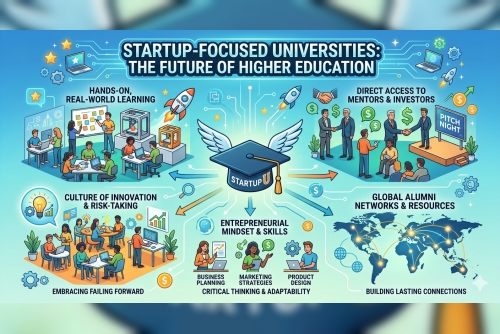
The landscape of higher education is undergoing a seismic shift. For decades, universities have been measured by the thickness of their textbooks and the prestige of their lecture halls. But a new breed of institution is rewriting the rules — and the results are impossible to ignore.
Startup-focused universities, like Swarrnim Startup & Innovation University in Gandhinagar, Gujarat — India's first university purpose-built for startups and innovation — are proving that the future of higher education isn't just about degrees. It's about creating doers.
The Problem with Traditional Higher Education
Traditional universities were designed for a different era — one where knowledge was scarce, careers were linear, and employers simply wanted degree holders. Today, the world demands creative problem-solvers, risk-takers, and self-starters who can build something from nothing.
Graduates from conventional institutions often step out into the world armed with theoretical knowledge but little practical experience. They know about business but have never run one. They've studied innovation but never innovated. The gap between academia and the real economy has never been wider.
What Makes Startup-Focused Universities Different?
1. Learning by Building
At Swarrnim, the philosophy is clear: disciplines like Engineering, Design, Science, and Management don't exist in isolation — they gain value through innovation, startups, and entrepreneurship. Every subject is taught with a real-world application in mind. Students don't just write assignments; they build ventures.
2. Incubation Centres on Campus
One of the most powerful differentiators of startup universities is their on-campus incubation infrastructure. Swarrnim's Incubation Centre gives students the rare opportunity to launch actual businesses while still in college — with access to mentors, funding pathways, and industry networks. This transforms classrooms into launchpads.
3. Entrepreneurship as a Core Mindset
Through dedicated programs like the IE (Innovation & Entrepreneurship) Department, students are immersed in startup culture from day one. Hackathons, pitch competitions, and industry linkages aren't extracurricular add-ons — they are woven into the academic fabric.
4. Multidisciplinary Collaboration
The hub-and-spoke model at Swarrnim brings together students from technology, design, management, pharmacy, and the sciences under one entrepreneurial umbrella. This mirrors how the real startup world works — diverse teams solving complex problems together.
Why This Model Is the Future
India is now the third-largest startup ecosystem in the world. Global economies are increasingly powered not by large corporations alone, but by agile, innovative startups. The demand for entrepreneurially-trained graduates is exploding — and conventional universities simply aren't keeping up.
Startup-focused institutions address this by producing graduates who are employment-ready and employment-creating. They don't just fill jobs — they generate them.
Moreover, the recognition is growing. Swarrnim has received acknowledgment from ARIIA, IIC, and MHRD for its innovation ecosystem, and has earned endorsements from Union Cabinet Ministers, Olympic champions, and industry leaders alike — a testament to how seriously the world is taking this model.
The Takeaway
Higher education must evolve — or become irrelevant. Startup-focused universities aren't a trend; they are the inevitable response to a world that values creation over memorisation, impact over compliance, and entrepreneurship over employment alone.
Institutions like Swarrnim Startup & Innovation University aren't just training the workforce of tomorrow — they are building the architects of it.
The future of education isn't in a lecture hall. It's in a startup.
Interested in joining India's first startup-focused university? Visit swarrnim.edu.in to explore programs and apply.



 Casino Non AAMS Sicuri e Affidabili per Slot Online nel 2026