



Handmade rugs are worth buying when you want quality that holds up, character that improves with age, and a piece that doesn't need replacing every few years. Machine-made rugs have their place, but they're a different product entirely. This article breaks down exactly what separates the two, so you can make a decision based on what actually matters for your home and your budget.
What the Manufacturing Process Actually Determines
The way a rug is made shapes everything about how it performs. This isn't marketing. It's physics.
A machine-made rug is produced at speed, with fibres tufted or woven by automated looms that prioritise consistency and volume. The result is a uniform surface with predictable patterns and a construction that, while reliable, lacks the structural depth of something made by hand. Handmade rugs are built thread by thread, with a human controlling tension, pattern, and pace. That process creates a density and integration in the weave that machines don't replicate. The fibres don't just sit on the surface. They're locked into the structure of the rug itself.
That distinction matters most when the rug is under pressure, literally. Heavy furniture, constant foot traffic, years of use. A handmade construction holds. A machine-made one compresses, flattens, and eventually loses the pile that made it look good in the first place.
The Role of Material in the Handmade vs Machine-Made Debate
Construction is one-half of the equation. Material is the other, and the two are deeply connected.
Handmade rugs are most commonly crafted from natural fibres, wool especially, because natural fibres respond well to hand tension and hold their shape through the weaving process. Wool in particular has a crimp in its structure that gives it memory, bounce, and a durability that synthetic fibres don't naturally possess. Modern wool rugs made by hand combine that inherent material strength with contemporary design sensibility, producing pieces that work in current Australian interiors without looking like they belong in a heritage collection.
Machine-made rugs, by contrast, are often produced in synthetic fibres like polypropylene or nylon. These materials are cheaper, easier to process at scale, and more uniform in appearance. They're not without merit, but they don't age the way natural fibres do. They fade, they pill, and they flatten in ways that wool simply doesn't.
What Handmade Rugs Bring to a Room That Others Don't
Beyond durability and material, there's a quality to handmade rugs that's harder to quantify but immediately obvious in a room. Call it warmth, character, presence. Whatever the word, it comes down to the fact that no two handmade pieces are identical.
The slight variation in tension across the surface, the tonal depth that comes from natural dye absorption, the way the pile catches light at different angles throughout the day — these are qualities that emerge from human craft and can't be engineered into a machine-made product. Modern wool rugs that are handmade carry this quality naturally. They bring a layer of visual interest that holds up over time, rather than looking exactly the same on day one as they do five years later.
In Australian homes that favour natural materials, considered interiors, and pieces with a sense of provenance, handmade is increasingly the standard rather than the exception.
How to Tell the Difference When You're Shopping
Knowing what to look for saves you from paying a handmade price for a machine-made product. The back of the rug is the most reliable indicator.
On a genuine handmade rug, the pattern is clearly visible from the reverse side, with individual knots or weave lines apparent to the eye and touch. The fringe, if present, grows directly from the warp threads rather than being stitched or glued on afterwards. Machine-made rugs have a backing material applied separately, which conceals the construction and gives the underside a flat, fabric-like appearance.
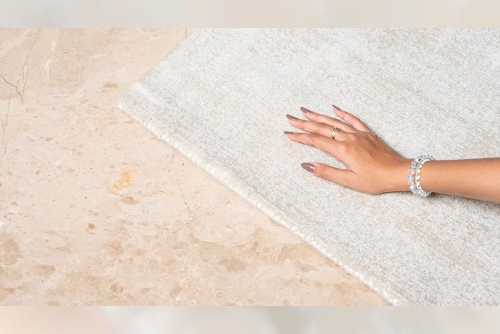
Feel the pile. Handmade rugs have a texture that varies subtly across the surface. Run your hand against the pile and with it. The difference in resistance is noticeable. A machine-made pile is more uniform and often feels slightly plasticky in synthetic versions, even when marketed as premium.
The Honest Case for Machine-Made
Not every room needs a handmade piece, and it's worth saying that plainly.
For rental properties, children's rooms, or spaces where the rug is likely to be replaced within a few years anyway, a quality machine-made option makes practical sense. Modern wool rugs at the machine-made end of the market have improved considerably and offer solid performance for the price. The issue arises when buyers pay near-handmade prices for machine-made products without understanding what they're actually getting.
If longevity, craft, and genuine material quality are the priorities, handmade wins clearly and consistently.
Buy Once, Buy Right
The cost of a handmade rug looks different when you measure it against how long it lasts. A well-made piece in quality wool, cared for properly, will outlast multiple machine-made replacements and still look better at the end of it. That's not a luxury argument. It's a practical one. The floor is the foundation of a room. Getting it right the first time is always the smarter spend.



 I migliori siti di poker online gratis per Texas Hold’em e Omaha nel 2026